
More insights.


Subscribe to our newsletter.
Driving Europe’s AM future through collaboration, strategy, and ecosystem intelligence.
A Strategic Step Forward for Europe’s AM Ecosystem
Europe stands at a defining moment in the evolution of Additive Manufacturing (AM). Over the past decade, AM has transitioned from a promising technology to a strategic industrial capability—already reshaping sectors such as aerospace, healthcare, mobility, energy, and advanced consumer goods.
Yet, despite Europe’s strong industrial base, world-class research ecosystem, and technological leadership in many AM domains, its full potential remains constrained by fragmentation.
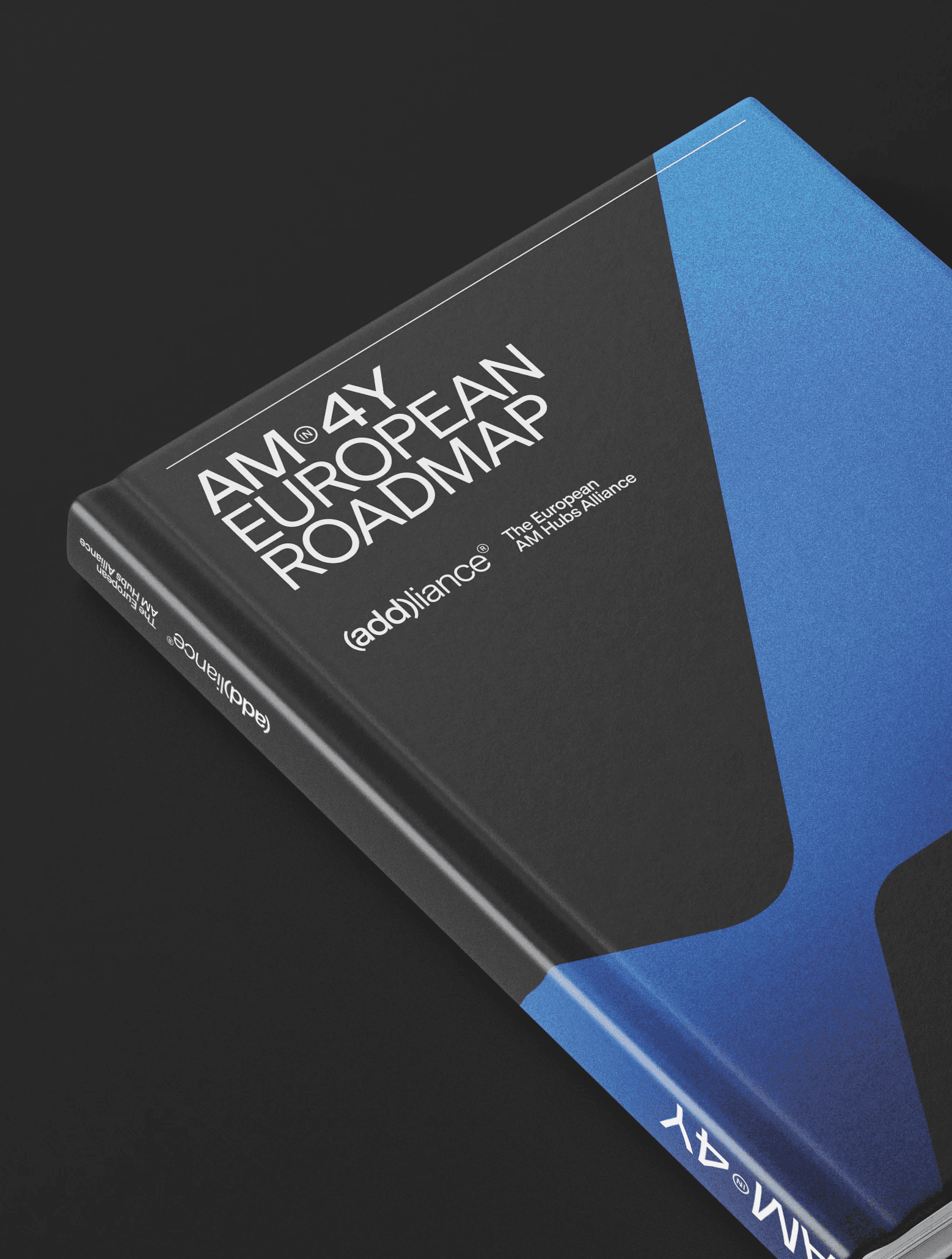
Today marks a pivotal milestone: the launch of the European AM Roadmap, a strategic initiative developed collaboratively within Addliance, bringing together leading AM hubs, associations, and ecosystems from across Europe.
From Fragmentation to Strategic Alignment
Across Europe, many countries have made significant progress in developing national AM strategies. These initiatives often share common ambitions—accelerating industrial adoption, strengthening innovation capabilities, fostering talent, and enhancing competitiveness.
However, they are too often pursued in isolation.
The result is a landscape where efforts are duplicated, resources are dispersed, and opportunities for scale are missed. The European AM Roadmap addresses this challenge by identifying and consolidating shared priorities, creating a unified strategic framework that enables coordinated action at the European level—while reinforcing national strengths.
This is not about replacing local strategies. It is about connecting them.
A Holistic Vision Across the Entire Value Chain
One of the defining strengths of the European AM Roadmap is its holistic approach, embracing the full complexity of the AM ecosystem.
From the industry perspective, it integrates insights from key sectors where AM is already driving transformation:
Aerospace and defense
Automotive and mobility
Energy
Healthcare and medical technologies
Consumer goods and sustainable products
At the same time, it incorporates the viewpoints of all actors across the AM value chain:
Machine and hardware manufacturers
Software developers
Material suppliers
Post-processing specialists
Service providers
Design, engineering, and production experts
Research, development, and innovation organizations
This dual lens—users and providers—ensures that the roadmap is both demand-driven and technologically grounded.
Beyond Technology: A Multi-Dimensional Framework
To unlock the full potential of AM, technological advancement alone is not sufficient. The European AM Roadmap adopts a multi-dimensional perspective, integrating key enabling frameworks:
Policy and governance: Supporting coherent policymaking and regulatory alignment across Europe
Sustainability and ecology: Positioning AM as an enabler of circularity, resource efficiency, and decarbonization
Talent and education: Addressing skills gaps and preparing the next generation of professionals
Investment and industrialization: Facilitating access to funding and scaling industrial deployment
Research and innovation: Strengthening collaboration and accelerating technology transfer
By connecting these dimensions, the roadmap provides a comprehensive foundation for action—bridging the gap between vision and execution.
A Pan-European Perspective with National Depth
A unique feature of this initiative is its ability to combine a European-level vision with deep national insights. Through Addliance’s network, the roadmap integrates an overview of strategies, priorities, and capabilities across countries.
This approach highlights Europe’s diversity while uncovering opportunities for cross-border collaboration, specialization, and complementarities.
In doing so, the roadmap acts both as:
A strategic compass for Europe
A connector between national ecosystems
Strengthening Europe’s Global Position
In an increasingly competitive global landscape, regions such as North America and Asia are advancing rapidly through strong investment, coordinated strategies, and industrial scale.
Europe cannot afford to lag behind.
The European AM Roadmap serves as a strategic instrument to:
Reinforce industrial sovereignty
Accelerate innovation and market adoption
Enhance global competitiveness
Position Europe at the forefront of next-generation manufacturing
From Strategy to Action
The true value of the European AM Roadmap will be measured by its impact.
Its objective is clear: to translate alignment into action.
Over the next four years, the roadmap will define concrete priorities, initiatives, and collaborative actions. It will serve as a reference framework for industry leaders, policymakers, researchers, and investors—guiding decision-making and enabling more effective collaboration.
A Strategic Step Forward for Europe’s AM Ecosystem
Europe stands at a defining moment in the evolution of Additive Manufacturing (AM). Over the past decade, AM has transitioned from a promising technology to a strategic industrial capability—already reshaping sectors such as aerospace, healthcare, mobility, energy, and advanced consumer goods.
Yet, despite Europe’s strong industrial base, world-class research ecosystem, and technological leadership in many AM domains, its full potential remains constrained by fragmentation.
Today marks a pivotal milestone: the launch of the European AM Roadmap, a strategic initiative developed collaboratively within Addliance, bringing together leading AM hubs, associations, and ecosystems from across Europe.
From Fragmentation to Strategic Alignment
Across Europe, many countries have made significant progress in developing national AM strategies. These initiatives often share common ambitions—accelerating industrial adoption, strengthening innovation capabilities, fostering talent, and enhancing competitiveness.
However, they are too often pursued in isolation.
The result is a landscape where efforts are duplicated, resources are dispersed, and opportunities for scale are missed. The European AM Roadmap addresses this challenge by identifying and consolidating shared priorities, creating a unified strategic framework that enables coordinated action at the European level—while reinforcing national strengths.
This is not about replacing local strategies. It is about connecting them.
A Holistic Vision Across the Entire Value Chain
One of the defining strengths of the European AM Roadmap is its holistic approach, embracing the full complexity of the AM ecosystem.
From the industry perspective, it integrates insights from key sectors where AM is already driving transformation:
Aerospace and defense
Automotive and mobility
Energy
Healthcare and medical technologies
Consumer goods and sustainable products
At the same time, it incorporates the viewpoints of all actors across the AM value chain:
Machine and hardware manufacturers
Software developers
Material suppliers
Post-processing specialists
Service providers
Design, engineering, and production experts
Research, development, and innovation organizations
This dual lens—users and providers—ensures that the roadmap is both demand-driven and technologically grounded.
Beyond Technology: A Multi-Dimensional Framework
To unlock the full potential of AM, technological advancement alone is not sufficient. The European AM Roadmap adopts a multi-dimensional perspective, integrating key enabling frameworks:
Policy and governance: Supporting coherent policymaking and regulatory alignment across Europe
Sustainability and ecology: Positioning AM as an enabler of circularity, resource efficiency, and decarbonization
Talent and education: Addressing skills gaps and preparing the next generation of professionals
Investment and industrialization: Facilitating access to funding and scaling industrial deployment
Research and innovation: Strengthening collaboration and accelerating technology transfer
By connecting these dimensions, the roadmap provides a comprehensive foundation for action—bridging the gap between vision and execution.
A Pan-European Perspective with National Depth
A unique feature of this initiative is its ability to combine a European-level vision with deep national insights. Through Addliance’s network, the roadmap integrates an overview of strategies, priorities, and capabilities across countries.
This approach highlights Europe’s diversity while uncovering opportunities for cross-border collaboration, specialization, and complementarities.
In doing so, the roadmap acts both as:
A strategic compass for Europe
A connector between national ecosystems
Strengthening Europe’s Global Position
In an increasingly competitive global landscape, regions such as North America and Asia are advancing rapidly through strong investment, coordinated strategies, and industrial scale.
Europe cannot afford to lag behind.
The European AM Roadmap serves as a strategic instrument to:
Reinforce industrial sovereignty
Accelerate innovation and market adoption
Enhance global competitiveness
Position Europe at the forefront of next-generation manufacturing
From Strategy to Action
The true value of the European AM Roadmap will be measured by its impact.
Its objective is clear: to translate alignment into action.
Over the next four years, the roadmap will define concrete priorities, initiatives, and collaborative actions. It will serve as a reference framework for industry leaders, policymakers, researchers, and investors—guiding decision-making and enabling more effective collaboration.